Zero yellowing under engine heat and solar UV.
Optical-grade platinum catalysis for TPU and PET paint protection film top coats and adhesive modification.
Where the process breaks down.
Paint protection film is judged years after it leaves the line. The defect that ends a warranty claim is rarely a cure failure; it is a slow colour shift. The top coat yellows, the film hazes, and the change usually appears first at edges and on horizontal panels where heat and UV accumulate. A conventional Karstedt's catalyst cures the film perfectly well and still fails this test.
The mechanism is thermo-oxidative rather than kinetic, so raising catalyst loading or oven temperature does not restore colour once the film has aged. The formulation has to be protected at the catalyst level: a grade that holds colour through long dwell times below 100°C, and a thermal grade where the part itself runs hot.
What the defect looks like.
- Film yellows and hazes after months of sun exposure and engine-bay heat radiation
- Colour drift shows first at the edges and on horizontal panels, then spreads
- Conventional catalyst fails the ΔE requirement before the film reaches end of warranty
What the formulation needs.
PC-42 is formulated to hold colour below 100°C for long dwell times, and it is the grade our PPF customers specify when the acceptance criterion is measured colour rather than visual judgement. PC-50 and PC-51 extend the thermal envelope to 150°C and above for top coats that see more heat.
PC-42 is the grade most PPF customers specify when the acceptance criterion is a measured colour difference rather than a visual judgement. PC-50 and PC-51 extend the thermal envelope above 150°C where the top coat or the substrate underneath reaches higher temperatures.
On a slot-die line the catalyst is only half the system. PC-611 or PC-612 at 0.1%–1.0% keeps the coating bath stable through the run without slowing cure once the film reaches oven temperature. Dosage stays inside the normal 0.05%–0.5% window and is set against line speed, not against colour.
How the first evaluation is run.
- Start from PC-42 unless the failure mode points to another grade.
- Hold catalyst dosage at the lower bound of 0.05%–0.5% and fix the inhibitor dose.
- Run the customer acceptance test on the cured part, not on the liquid mix.
- Change one variable per run: grade, dosage or inhibitor.
What the numbers behind this page show.
Where this grade is used.
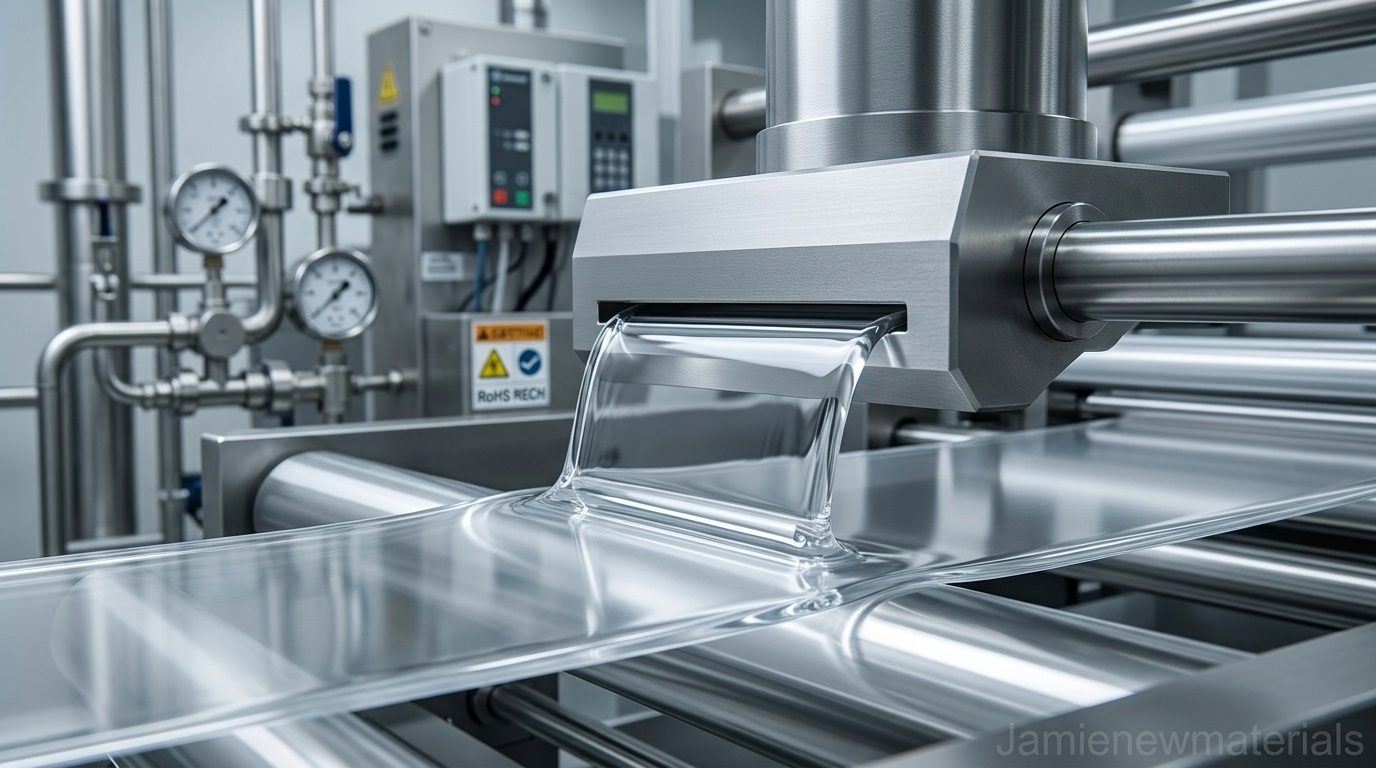
Representative production images of the processes these grades are specified for. The parts shown are end applications, not test data; measured values stay in the data sections above.
Measured, not claimed.
Schematics of the measurement behind the figures above: the same test conditions, drawn to be read at a glance. The drawings are illustrative; the measured values are the ones stated in the data sections.
Grades most often specified for PPF & Coatings.
Each card opens the grade page with full specification, packaging, shelf life and inhibitor pairing. Evaluation quantities are available across the range; the one exception is stated below.
5,000 PPM
The anti-yellowing benchmark. Under 85°C / 48 h accelerated aging, PC-42 holds ΔE 0.8 against 4.2 for a conventional Karstedt's catalyst. Specified into premium PPF top coats, optical films and any coating judged by colour after heat exposure.
Custom (1,000–20,000 PPM)
Ultra high-temperature grade with a low-viscosity profile (5–50 cP) for easy dispersion. Remains stable above 150°C for long dwell times, for thick sections and hot-running parts.
Custom (1,000–20,000 PPM)
The heat-resistance upgrade grade. Beyond its own thermal stability, PC-51 lifts the heat resistance of the whole compound: methyl silicone toward phenyl performance, phenyl toward fluoro. Used where the part specification is set by heat aging.
Settings for the first trial.
Typical starting parameters for PPF & Coatings. Treat them as a trial configuration rather than a fixed recipe: the final values depend on the substrate, the equipment and the acceptance test.
| Parameter | Guidance |
|---|---|
| Catalyst dosage | 0.05%–0.5% of total compound; start at the lower bound and adjust to line speed |
| Inhibitor | PC-611 or PC-612 at 0.1%–1.0% for line stability |
| Cure window | 80–120°C depending on substrate; avoid over-cure on thin films |
| Coating method | Slot-die and gravure; 400–500 cP is the typical catalyst viscosity range |
Add base and inhibitor first, then the catalyst. Do not allow direct contact with hydrogen-containing silicone oil or pure inhibitor before mixing. Shake the container before use, and keep drums sealed at 5–15°C away from direct light.
How this looks on a production line.
Measured outcomes for this application, with the challenge and the test conditions stated. Results are customer production data where noted; accelerated aging results name the comparison catalyst.
Practical questions before a trial.
The questions that come up most often when this application moves from specification to a first sample run.
Which grade should we evaluate first for PPF & Coatings?
PC-42 or PC-50 is the usual starting point. Start at the lower end of the 0.05%–0.5% dosage range and confirm the cure against your own oven before adjusting.
How do we control pot life without slowing the cure?
PC-611 or PC-612 at 0.1%–1.0% for line stability. The inhibitor sets working time; the catalyst sets cure speed once the part reaches temperature. Change one of them at a time.
How does a trial move from sample to production?
Request an evaluation sample with the formulation window and acceptance test. Samples are paired with the matching inhibitor so the first trial reflects the real process; after the dosage is confirmed, supply scales from 1 kg to 5 kg and 20 kg drums with a batch COA.
Trial PPF & Coatings with a paired sample set.
Send the cure temperature, the failure you are seeing and the acceptance test. We reply with a recommended grade, platinum concentration and inhibitor pairing, plus a sample plan for the first run.