Medical LSR diaphragm: 100 steam cycles without yellowing
A respiratory valve diaphragm assessed after 100 cycles of 121°C wet-heat sterilisation, where the acceptance criteria were colour and yield rather than tensile strength.
Each figure is tied to a measurement, and the result section below states the conditions that produced it. Field data and accelerated aging data are labelled separately, and the disclosure at the end of the case states how the data was obtained.
Measured, not claimed.
Schematic of the measurement behind this case: the same conditions, drawn to be read at a glance. The drawing is illustrative; the measured values are the ones stated in the result sections.
Where this grade is used.
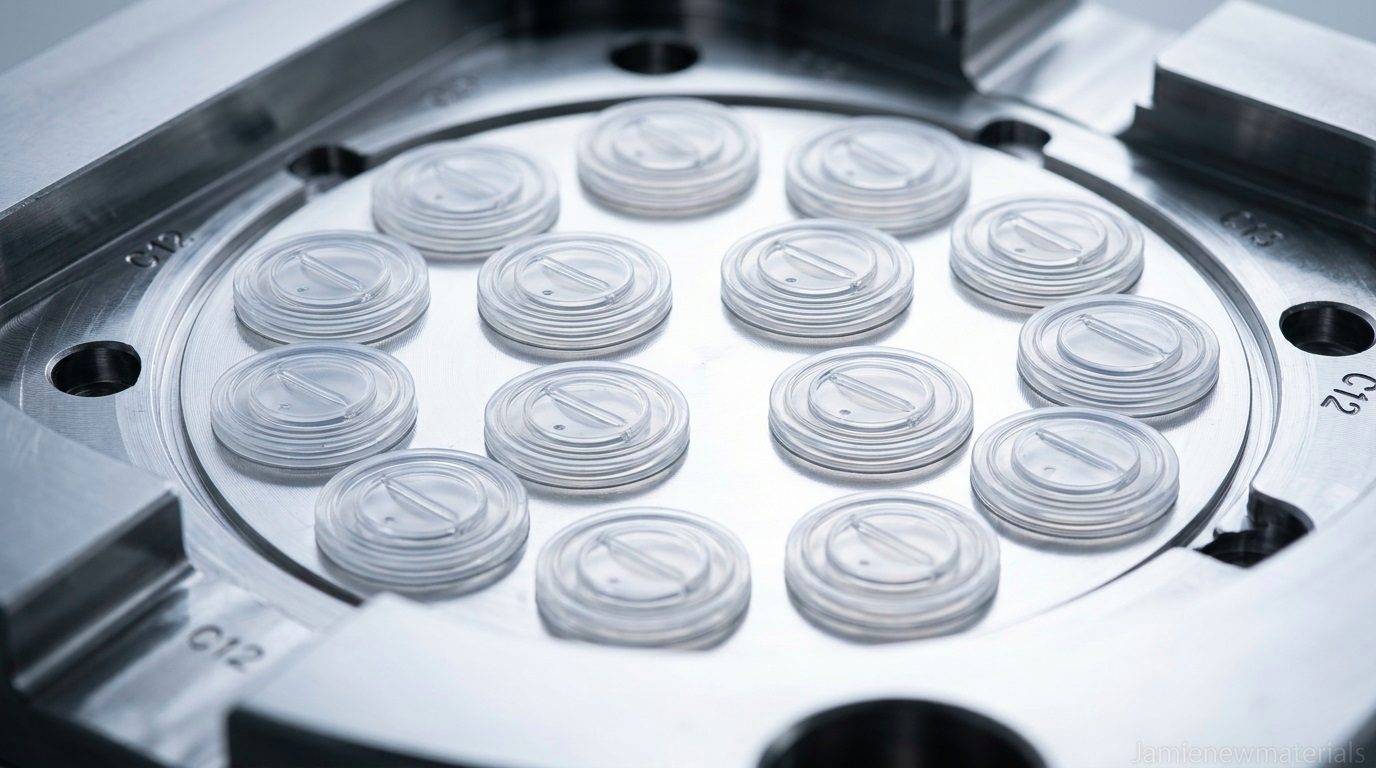
Representative production images of the processes these grades are specified for. The parts shown are end applications, not test data; measured values stay in the data sections above.
The challenge.
A respiratory valve diaphragm had to survive repeated 121°C wet-heat sterilisation without visible colour change. With the incumbent catalyst, yield after sterilisation was 82% and rejected parts were discoloured.
The cost sits at the end of the process. The moulding work and the material are already spent before the part fails inspection, so a yield loss at sterilisation is more expensive than the same loss at moulding. Colour retention had to be solved in the formulation rather than sorted out in inspection.
Repeated steam exposure is a different test from a single cure check. A part can pass the first sterilisation and still discolour at cycle 60, which is why the case was validated over the full 100-cycle protocol instead of a short screening run.
The solution.
8,000 PPM medical LSR formulation with PC-42 anti-yellowing catalyst, validated through 100 wet-heat sterilisation cycles.
The project was run as a customer-validated field case: the compound was moulded into the production part geometry and validated through the full exposure, not screened on plaques. That is the only way to connect a catalyst grade to a yield number.
The catalyst addresses colour; the inhibitor package sets the working time on the injection line. Keeping those two decisions separate is what allows the formulation to be adjusted without re-qualifying the colour result.
The result, and what produced it.
The numbers at the top of the page are the headline metrics from this case. The paragraphs here explain what produced them, with the test method and the exposure stated alongside.
Yellowness index stayed at or below 1.5 through 100 cycles and line yield moved from 82% to 98%. Both figures are specific to this formulation and this sterilisation protocol.
The result does not establish shelf life, biocompatibility or regulatory clearance. It states that this formulation retained colour and improved yield under this protocol.
Sterilisation validation is part-specific. A change of wall thickness, cycle profile or steam quality is a reason to repeat the colour measurement, not to rely on this result.
Customer field case. Yellowness index measured after 100 cycles of 121°C wet-heat sterilisation; the device is a Class II end device, and this case does not imply regulatory approval of the catalyst itself.
Customer-validated field case. The FDA Class II reference describes the end-device category only, not the catalyst.
The grades and the application behind this case.
Every case is tied to a catalyst grade and to an application page. The grade page carries the full specification; the application page carries the process window, dosage range and inhibitor pairing for this class of part.
| Model | Pt concentration | Viscosity | Recommended dosage |
|---|---|---|---|
| PC-42 | 5,000 PPM | 300–500 cP | 0.05%–0.5% of total compound |
Open a model for packaging, shelf life, features and inhibitor pairing. Where a case names more than one grade, the solution section states which one was used in the reported trial.
LSR Medical/Food
Addition cure with no by-products.
Platinum-catalysed, VOC-free systems for medical tubing, respiratory valves, baby teats and bakeware.
Other problems, measured the same way.
Each case is structured identically, so the challenge, solution and result can be compared across industries with the same reading discipline.
Battery pack seal: VOC compliance without losing compression set
A battery pack seal was built on a peroxide cure system. VOC emissions failed the customer's incoming specification, and the alternative addition-cure trial produced uneven cell structure and compression set above the 10% limit.
Mini LED encapsulation: 99.82% transmittance at 95% yield
A high-refractive-index encapsulation compound clouded when the catalyst was added, and the resulting light scattering failed the transmittance target. Yield was limited by optical rejects rather than by the dispenser.
MLCC release film: 15-minute cure, +12% yield
The coater could not reach the surface roughness target of 0.2 μm at production speed because the silicone layer was not fully cross-linked when the film was wound.
Run a comparable trial on your own line.
Send the part, the failure and the acceptance test. We will send evaluation samples of the grade used in this case, paired with the matching inhibitor, and confirm the starting dosage for your cure window.