Instant cure at several hundred metres per minute.
High-activity catalysis for electronic labels, tapes and hygiene release liners, where line speed is the production limit.
Where the process breaks down.
Release coating looks like a chemistry problem and is usually a speed problem. The coater can run at several hundred metres per minute; the limit is how fast the silicone can cross-link before the film is wound. When cure is incomplete at wind-up, the defect surfaces later as silicone migration, rub-off or a release force that drifts between lots.
Because the failure is invisible at the coater, lines often compensate by slowing down, which converts a chemistry issue into a capacity cost. The practical fix is a catalyst with enough activity to complete cross-link at line speed, paired with an inhibitor that keeps the bath workable through the shift.
What the defect looks like.
- Line speed is capped by how fast the silicone can cross-link, not by the coater
- Incomplete cure shows up later as silicone migration or rub-off
- Release force drifts between lots when catalyst reactivity is inconsistent
What the formulation needs.
The standard PC-11 to PC-16 grades are the volume solution for high-speed release coating: high activity, complete cross-link under fast line speeds, and stable release force lot to lot. Batch-controlled -1 grades are used where coat weight is measured.
The standard PC-11 to PC-16 grades exist for this trade-off: six platinum concentrations from 1,500 to 5,000 PPM, all at 400–500 cP and compatible with the full inhibitor range. Higher loading shortens the dwell needed for complete cross-link; lower loading protects catalyst cost where the line has margin.
Where coat weight and cure are measured rather than estimated, the batch-controlled -1 grades keep drum-to-drum reactivity inside a tight tolerance. PC-617, dosed at 0.01%–0.20%, is the option when the oven can run at approximately 140°C.
How the first evaluation is run.
- Start from PC-11 unless the failure mode points to another grade.
- Hold catalyst dosage at the lower bound of 0.05%–0.5% and fix the inhibitor dose.
- Run the customer acceptance test on the cured part, not on the liquid mix.
- Change one variable per run: grade, dosage or inhibitor.
What the numbers behind this page show.
Where this grade is used.
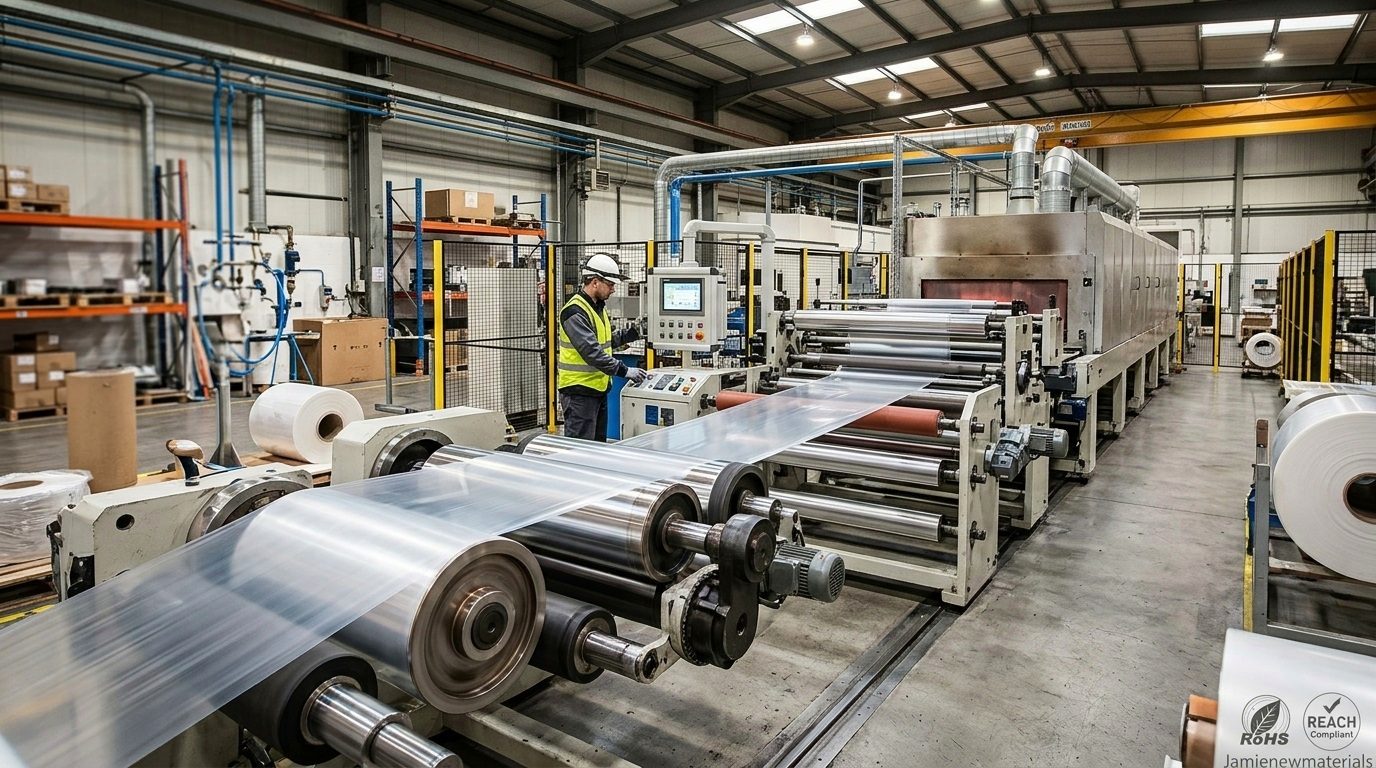
Representative production images of the processes these grades are specified for. The parts shown are end applications, not test data; measured values stay in the data sections above.
Measured, not claimed.
Schematics of the measurement behind the figures above: the same test conditions, drawn to be read at a glance. The drawings are illustrative; the measured values are the ones stated in the data sections.
Grades most often specified for Release Liners.
Each card opens the grade page with full specification, packaging, shelf life and inhibitor pairing. Evaluation quantities are available across the range; the one exception is stated below.
1,500 PPM
The general-purpose grade. 1,500 PPM is the most widely used concentration for large-volume silicone compounding, where a predictable cure at moderate catalyst cost matters more than speed.
5,000 PPM
The high-concentration workhorse. 5,000 PPM delivers fast cross-linking for lines that need short cycle times, and it is the grade most often specified for injection and rapid-cure processes.
3,000 PPM
The middle grade, chosen when 1,500 PPM is too slow and 5,000 PPM is more catalyst than the formulation needs. A common starting point for balancing cure speed against raw-material cost.
4,000 PPM
High-activity grade for automated production lines, where consistent cure start and short residence time reduce scrap at start-up and shut-down.
2,000 PPM
The default grade for industrial silicone moulding. 2,000 PPM sits between the economy and high-speed grades and is the grade most often used to match an existing moulding formulation.
4,000 PPM-1
A batch-controlled 4,000 PPM grade for high-precision coating lines. The -1 suffix denotes the tight-tolerance batch configuration used where coat weight and cure are measured, not estimated.
Settings for the first trial.
Typical starting parameters for Release Liners. Treat them as a trial configuration rather than a fixed recipe: the final values depend on the substrate, the equipment and the acceptance test.
| Parameter | Guidance |
|---|---|
| Catalyst dosage | 0.05%–0.5%; higher activity grades allow the lower end |
| Inhibitor | PC-611 / 612 for bath stability; PC-617 when a higher cure temperature is available |
| Line speed | Set by cure, not by coater; verify full cross-link with rub-off test |
| Surface target | Ra ≤ 0.2 μm for MLCC; release force stable across the lot |
Add base and inhibitor first, then the catalyst. Do not allow direct contact with hydrogen-containing silicone oil or pure inhibitor before mixing. Shake the container before use, and keep drums sealed at 5–15°C away from direct light.
How this looks on a production line.
Measured outcomes for this application, with the challenge and the test conditions stated. Results are customer production data where noted; accelerated aging results name the comparison catalyst.
Practical questions before a trial.
The questions that come up most often when this application moves from specification to a first sample run.
Which grade should we evaluate first for Release Liners?
PC-11 or PC-12 is the usual starting point. Start at the lower end of the 0.05%–0.5% dosage range and confirm the cure against your own oven before adjusting.
How do we control pot life without slowing the cure?
PC-611 / 612 for bath stability; PC-617 when a higher cure temperature is available. The inhibitor sets working time; the catalyst sets cure speed once the part reaches temperature. Change one of them at a time.
How does a trial move from sample to production?
Request an evaluation sample with the formulation window and acceptance test. Samples are paired with the matching inhibitor so the first trial reflects the real process; after the dosage is confirmed, supply scales from 1 kg to 5 kg and 20 kg drums with a batch COA.
Trial Release Liners with a paired sample set.
Send the cure temperature, the failure you are seeing and the acceptance test. We reply with a recommended grade, platinum concentration and inhibitor pairing, plus a sample plan for the first run.