Addition cure with no by-products.
Platinum-catalysed, VOC-free systems for medical tubing, respiratory valves, baby teats and bakeware.
Where the process breaks down.
Medical and food-contact parts are specified by what the material releases and how it survives sterilisation. Peroxide cure leaves by-products that fail that review, which is why addition-cure platinum systems are the default for tubing, respiratory valves, teats and bakeware. Switching systems, however, exposes the next failure: colour and yield after repeated steam cycles.
With the wrong catalyst, clear silicone turns yellow through 121°C wet-heat sterilisation, and the loss shows up at the end of the process after the expensive moulding work is complete. Yield, not tensile strength, is usually what moves first.
What the defect looks like.
- Peroxide systems release by-products that fail medical and food-contact review
- Repeated steam sterilisation turns clear silicone yellow
- Yield drops at the sterilisation step, after the expensive moulding work is done
What the formulation needs.
Addition-cure platinum systems release no by-products and comply with RoHS and REACH. PC-42 holds colour through repeated 121°C steam cycles; the high-activity grades protect yield on injection lines.
PC-42 holds colour through repeated 121°C cycles; the high-activity grades protect yield on injection lines where cycle time is short. The system releases no by-products during cure, and the compliance statement is limited to what can be documented: compliant with RoHS and REACH.
Sterilisation performance has to be validated on the part rather than assumed from a catalyst datasheet. A trial normally runs the full cycle count and checks yellowness index and mechanical properties at the end, because that is the point at which the part is accepted or rejected.
Compliance documentation for the catalyst covers RoHS and REACH only. Medical case data on this site describes customer-validated field cases, and the FDA Class II reference in that case describes the end-device category. It is not a certification or approval of the catalyst.
How the first evaluation is run.
- Start from PC-42 unless the failure mode points to another grade.
- Hold catalyst dosage at the lower bound of 0.05%–0.5% and fix the inhibitor dose.
- Run the customer acceptance test on the cured part, not on the liquid mix.
- Change one variable per run: grade, dosage or inhibitor.
What the numbers behind this page show.
Where this grade is used.
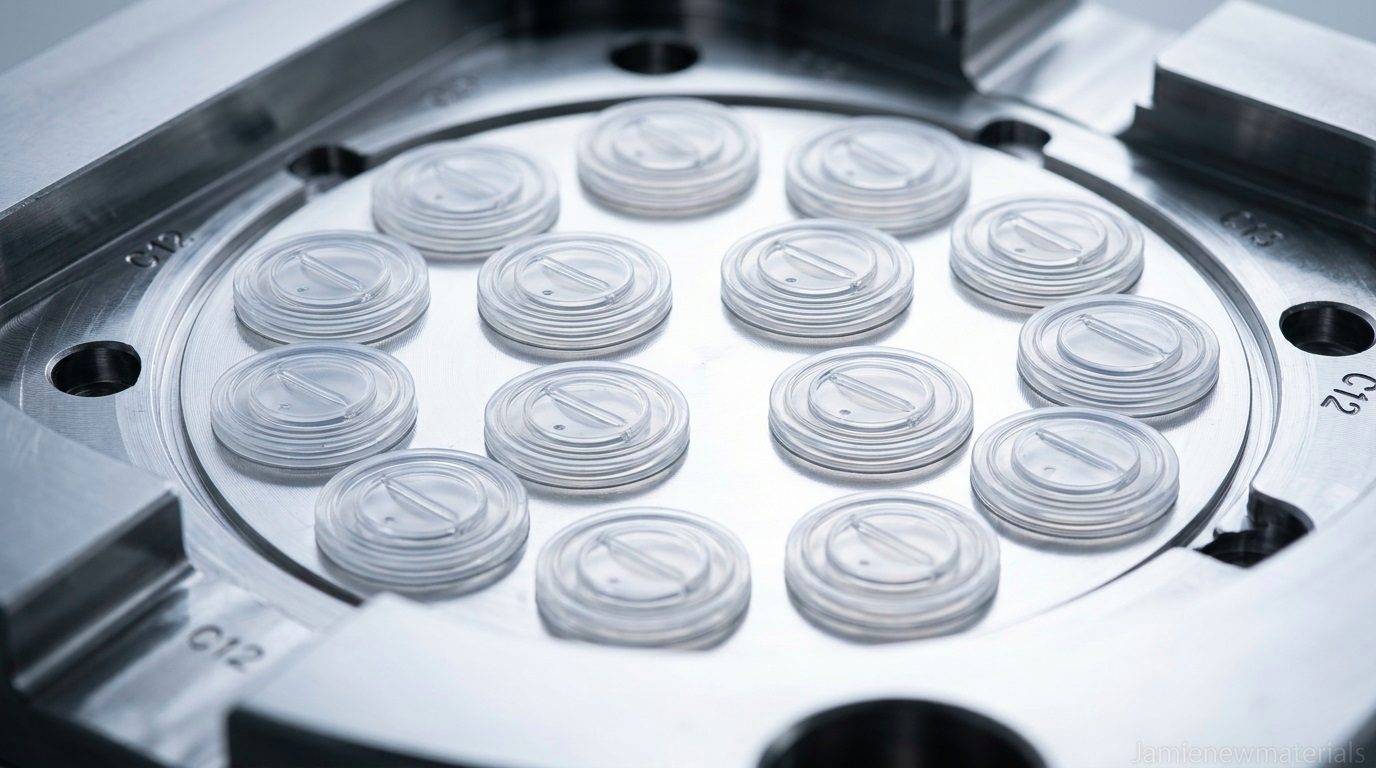
Representative production images of the processes these grades are specified for. The parts shown are end applications, not test data; measured values stay in the data sections above.
Measured, not claimed.
Schematics of the measurement behind the figures above: the same test conditions, drawn to be read at a glance. The drawings are illustrative; the measured values are the ones stated in the data sections.
Grades most often specified for LSR Medical/Food.
Each card opens the grade page with full specification, packaging, shelf life and inhibitor pairing. Evaluation quantities are available across the range; the one exception is stated below.
5,000 PPM
The anti-yellowing benchmark. Under 85°C / 48 h accelerated aging, PC-42 holds ΔE 0.8 against 4.2 for a conventional Karstedt's catalyst. Specified into premium PPF top coats, optical films and any coating judged by colour after heat exposure.
5,000 PPM
The high-concentration workhorse. 5,000 PPM delivers fast cross-linking for lines that need short cycle times, and it is the grade most often specified for injection and rapid-cure processes.
Custom (1,000–20,000 PPM)
The heat-resistance upgrade grade. Beyond its own thermal stability, PC-51 lifts the heat resistance of the whole compound: methyl silicone toward phenyl performance, phenyl toward fluoro. Used where the part specification is set by heat aging.
Settings for the first trial.
Typical starting parameters for LSR Medical/Food. Treat them as a trial configuration rather than a fixed recipe: the final values depend on the substrate, the equipment and the acceptance test.
| Parameter | Guidance |
|---|---|
| Catalyst dosage | 0.05%–0.5% of total compound |
| Inhibitor | PC-613 / 614 for ambient handling, PC-611 / 612 for hot cure |
| Sterilisation | Validate colour and mechanical properties after 100 cycles |
| Compliance | RoHS and REACH statements available on request |
Add base and inhibitor first, then the catalyst. Do not allow direct contact with hydrogen-containing silicone oil or pure inhibitor before mixing. Shake the container before use, and keep drums sealed at 5–15°C away from direct light.
How this looks on a production line.
Measured outcomes for this application, with the challenge and the test conditions stated. Results are customer production data where noted; accelerated aging results name the comparison catalyst.
Practical questions before a trial.
The questions that come up most often when this application moves from specification to a first sample run.
Which grade should we evaluate first for LSR Medical/Food?
PC-42 or PC-12 is the usual starting point. Start at the lower end of the 0.05%–0.5% dosage range and confirm the cure against your own oven before adjusting.
How do we control pot life without slowing the cure?
PC-613 / 614 for ambient handling, PC-611 / 612 for hot cure. The inhibitor sets working time; the catalyst sets cure speed once the part reaches temperature. Change one of them at a time.
Is the catalyst approved for medical or food-contact use?
No. Medical and food-contact compliance is assessed on the finished device or article, not on the catalyst. The catalyst is supplied with RoHS and REACH statements. The medical case on this site is a customer-validated field case, and its FDA Class II reference describes the end-device category only.
Trial LSR Medical/Food with a paired sample set.
Send the cure temperature, the failure you are seeing and the acceptance test. We reply with a recommended grade, platinum concentration and inhibitor pairing, plus a sample plan for the first run.